The Debut of a Visionary: Kay Nielsen’s In Powder and Crinoline
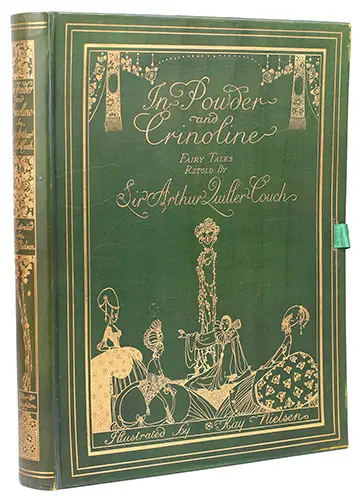
Every great artist has a moment of arrival—a work that announces their singular vision to the world. For Kay Nielsen, that moment came in 1913 with the publication of In Powder and Crinoline, a collection of fairy tales retold by Sir Arthur Quiller-Couch and brought to life through Nielsen’s luminous, otherworldly illustrations. It was a debut that stopped the art world in its tracks, introducing a new voice so distinctive, so utterly original, that it immediately placed the young Danish artist among the luminaries of the Golden Age of Illustration.
Kay Nielsen was only twenty-seven when In Powder and Crinoline appeared. Born in Copenhagen in 1886 into a theatrical family—his father was a prominent actor and director, his mother a celebrated actress—he had absorbed from childhood a sense of drama, costume, and stagecraft that would permeate his artistic vision. After studies in Paris at the Académie Julian and the Académie Colarossi, he had developed a style that defied easy categorization. It drew upon the sinuous lines of Art Nouveau, the flattened perspectives of Japanese prints, the intricate patterning of Persian miniatures, and a distinctly Nordic sensibility—a blend of melancholy and grandeur that set him apart from his contemporaries.
In Powder and Crinoline (later republished as Twelve Dancing Princesses and Other Fairy Tales) presents a collection of stories drawn from the rich tradition of European folklore. The title itself evokes the world Nielsen would so exquisitely render: an eighteenth-century-inspired realm of elegant courts, grand ballrooms, and heroines whose gowns billow with impossible grace. Yet within this world of surface beauty, deeper currents flow—themes of longing, transformation, and the mysterious forces that shape human fate.
Published by Hodder & Stoughton in London, the book was produced as a lavish gift volume, befitting its ambition. It contained twenty-eight tipped-in color plates, each mounted on heavy paper and protected by captioned tissue guards, alongside a wealth of black-and-white illustrations and decorative elements that wove themselves throughout the text. From the intricate borders to the delicate headpieces, every page bore the imprint of Nielsen’s hand—a total work of art conceived with meticulous care.
What immediately strikes the viewer of Nielsen’s illustrations is their extraordinary combination of elegance and emotional depth. His figures possess an elongated, almost ethereal grace, their limbs slender, their postures poised between movement and stillness. The heroines wear gowns that seem to defy gravity, their folds and flourishes rendered with a decorative precision that owes as much to fashion illustration as to fairy-tale fantasy. Yet there is nothing frivolous about these images. Beneath the surface beauty lies a profound sense of atmosphere—a hint of melancholy, a whisper of the unknown.
Nielsen’s palette in In Powder and Crinoline ranges from the delicate to the dramatic. Soft golds, dusty roses, and muted blues dominate many plates, creating an atmosphere of dreamlike nostalgia. Yet he was equally capable of bold, arresting compositions—deep crimsons, rich purples, and luminous whites that seem to glow from within. The interplay of color and line is masterful, each element carefully balanced to draw the viewer into a world that feels both familiar and utterly magical.
Among the most celebrated illustrations in the volume is the depiction of the twelve dancing princesses, their gowns swirling in a midnight revel beneath a moonlit sky. The composition is a triumph of decorative patterning—the sinuous lines of the princesses’ dresses echoing the curves of the trees and the clouds, the whole scene suspended in a moment of enchanted movement. Another notable plate shows a princess pursued by a troll, the monstrous figure rendered with a grotesque elegance that never descends into mere horror, instead evoking the complex, often darker undertones of the original folklore.
Critics and collectors responded to In Powder and Crinoline with immediate enthusiasm. Here was an artist who had arrived fully formed, his style already mature, his vision already complete. The book established Nielsen’s reputation and paved the way for his even more celebrated follow-up, East of the Sun, West of the Moon, the following year.
Today, In Powder and Crinoline remains a treasure of the illustrated book tradition. Its images continue to captivate with their grace, their mystery, and their singular beauty. For those discovering Kay Nielsen’s work for the first time, it offers a perfect introduction—a glimpse into an enchanted world where powder and crinoline give way to something far more profound: the timeless art of a true visionary.
For admirers of this edition, these kindred works may intrigue:
• Red Magic (1930) also illustrated by Nielsen – his last majestic work
• The Sleeping Beauty (1920) illustrated by Edmund Dulac – for contrasting Edwardian treatment
• Andersen’s Fairy Tales (1924) – illustrated by Nielsen – showing his range
This is Kay Nielsen’s first illustrated book: In Powder and Crinoline: Old Fairy Tales Retold by Sir Arthur Quiller-Couchwas. Published by Hodder & Stoughton, London, 1913. Nielsen went on to illustrate East of the Sun, West of the Moon (1914), Andersen’s Fairy Tales (1924), Hansel and Gretel (1925) and Red Magic (1930).
Art Gallery: Kay Nielsen – In Powder and Crinoline 1913
![Kay Nielsen - In Powder and Crinoline [nielsen-crinoline01] (art, illustrations)](https://www.nocloo.com/wp-content/plugins/justified-image-grid/timthumb.php?src=https%3A%2F%2Fwww.nocloo.com%2Fart%2Fnielsen-powder%2Fnielsen-crinoline01.jpg&h=280&q=90&f=.jpg)
![Kay Nielsen - In Powder and Crinoline [nielsen-crinoline01a] (art, illustrations)](https://www.nocloo.com/wp-content/plugins/justified-image-grid/timthumb.php?src=https%3A%2F%2Fwww.nocloo.com%2Fart%2Fnielsen-powder%2Fnielsen-crinoline01a.jpg&h=280&q=90&f=.jpg)
![Kay Nielsen - In Powder and Crinoline [nielsen-crinoline02] (art, illustrations)](https://www.nocloo.com/wp-content/plugins/justified-image-grid/timthumb.php?src=https%3A%2F%2Fwww.nocloo.com%2Fart%2Fnielsen-powder%2Fnielsen-crinoline02.jpg&h=280&q=90&f=.jpg)
![Kay Nielsen - In Powder and Crinoline [nielsen-crinoline03] (art, illustrations)](https://www.nocloo.com/wp-content/plugins/justified-image-grid/timthumb.php?src=https%3A%2F%2Fwww.nocloo.com%2Fart%2Fnielsen-powder%2Fnielsen-crinoline03.jpg&h=280&q=90&f=.jpg)
![Kay Nielsen - In Powder and Crinoline [nielsen-crinoline04] (art, illustrations)](https://www.nocloo.com/wp-content/plugins/justified-image-grid/timthumb.php?src=https%3A%2F%2Fwww.nocloo.com%2Fart%2Fnielsen-powder%2Fnielsen-crinoline04.jpg&h=280&q=90&f=.jpg)
![Kay Nielsen - In Powder and Crinoline [nielsen-crinoline05] (art, illustrations)](https://www.nocloo.com/wp-content/plugins/justified-image-grid/timthumb.php?src=https%3A%2F%2Fwww.nocloo.com%2Fart%2Fnielsen-powder%2Fnielsen-crinoline05.jpg&h=280&q=90&f=.jpg)
![Kay Nielsen - In Powder and Crinoline [nielsen-crinoline06] (art, illustrations)](https://www.nocloo.com/wp-content/plugins/justified-image-grid/timthumb.php?src=https%3A%2F%2Fwww.nocloo.com%2Fart%2Fnielsen-powder%2Fnielsen-crinoline06.jpg&h=280&q=90&f=.jpg)
![Kay Nielsen - In Powder and Crinoline [nielsen-crinoline07] (art, illustrations)](https://www.nocloo.com/wp-content/plugins/justified-image-grid/timthumb.php?src=https%3A%2F%2Fwww.nocloo.com%2Fart%2Fnielsen-powder%2Fnielsen-crinoline07.jpg&h=280&q=90&f=.jpg)
![Kay Nielsen - In Powder and Crinoline [nielsen-crinoline08] (art, illustrations)](https://www.nocloo.com/wp-content/plugins/justified-image-grid/timthumb.php?src=https%3A%2F%2Fwww.nocloo.com%2Fart%2Fnielsen-powder%2Fnielsen-crinoline08.jpg&h=280&q=90&f=.jpg)
![Kay Nielsen - In Powder and Crinoline [nielsen-crinoline09] (art, illustrations)](https://www.nocloo.com/wp-content/plugins/justified-image-grid/timthumb.php?src=https%3A%2F%2Fwww.nocloo.com%2Fart%2Fnielsen-powder%2Fnielsen-crinoline09.jpg&h=280&q=90&f=.jpg)
![Kay Nielsen - In Powder and Crinoline [nielsen-crinoline10] (art, illustrations)](https://www.nocloo.com/wp-content/plugins/justified-image-grid/timthumb.php?src=https%3A%2F%2Fwww.nocloo.com%2Fart%2Fnielsen-powder%2Fnielsen-crinoline10.jpg&h=280&q=90&f=.jpg)
![Kay Nielsen - In Powder and Crinoline [nielsen-crinoline11] (art, illustrations)](https://www.nocloo.com/wp-content/plugins/justified-image-grid/timthumb.php?src=https%3A%2F%2Fwww.nocloo.com%2Fart%2Fnielsen-powder%2Fnielsen-crinoline11.jpg&h=280&q=90&f=.jpg)
![Kay Nielsen - In Powder and Crinoline [nielsen-crinoline12] (art, illustrations)](https://www.nocloo.com/wp-content/plugins/justified-image-grid/timthumb.php?src=https%3A%2F%2Fwww.nocloo.com%2Fart%2Fnielsen-powder%2Fnielsen-crinoline12.jpg&h=280&q=90&f=.jpg)
![Kay Nielsen - In Powder and Crinoline [nielsen-crinoline13] (art, illustrations)](https://www.nocloo.com/wp-content/plugins/justified-image-grid/timthumb.php?src=https%3A%2F%2Fwww.nocloo.com%2Fart%2Fnielsen-powder%2Fnielsen-crinoline13.jpg&h=280&q=90&f=.jpg)
![Kay Nielsen - In Powder and Crinoline [nielsen-crinoline14] (art, illustrations)](https://www.nocloo.com/wp-content/plugins/justified-image-grid/timthumb.php?src=https%3A%2F%2Fwww.nocloo.com%2Fart%2Fnielsen-powder%2Fnielsen-crinoline14.jpg&h=280&q=90&f=.jpg)
![Kay Nielsen - In Powder and Crinoline [nielsen-crinoline15] (art, illustrations)](https://www.nocloo.com/wp-content/plugins/justified-image-grid/timthumb.php?src=https%3A%2F%2Fwww.nocloo.com%2Fart%2Fnielsen-powder%2Fnielsen-crinoline15.jpg&h=280&q=90&f=.jpg)
![Kay Nielsen - In Powder and Crinoline [nielsen-crinoline16] (art, illustrations)](https://www.nocloo.com/wp-content/plugins/justified-image-grid/timthumb.php?src=https%3A%2F%2Fwww.nocloo.com%2Fart%2Fnielsen-powder%2Fnielsen-crinoline16.jpg&h=280&q=90&f=.jpg)
![Kay Nielsen - In Powder and Crinoline [nielsen-crinoline17] (art, illustrations)](https://www.nocloo.com/wp-content/plugins/justified-image-grid/timthumb.php?src=https%3A%2F%2Fwww.nocloo.com%2Fart%2Fnielsen-powder%2Fnielsen-crinoline17.jpg&h=280&q=90&f=.jpg)
![Kay Nielsen - In Powder and Crinoline [nielsen-crinoline18] (art, illustrations)](https://www.nocloo.com/wp-content/plugins/justified-image-grid/timthumb.php?src=https%3A%2F%2Fwww.nocloo.com%2Fart%2Fnielsen-powder%2Fnielsen-crinoline18.jpg&h=280&q=90&f=.jpg)
![Kay Nielsen - In Powder and Crinoline [nielsen-crinoline19] (art, illustrations)](https://www.nocloo.com/wp-content/plugins/justified-image-grid/timthumb.php?src=https%3A%2F%2Fwww.nocloo.com%2Fart%2Fnielsen-powder%2Fnielsen-crinoline19.jpg&h=280&q=90&f=.jpg)
![Kay Nielsen - In Powder and Crinoline [nielsen-crinoline20] (art, illustrations)](https://www.nocloo.com/wp-content/plugins/justified-image-grid/timthumb.php?src=https%3A%2F%2Fwww.nocloo.com%2Fart%2Fnielsen-powder%2Fnielsen-crinoline20.jpg&h=280&q=90&f=.jpg)
![Kay Nielsen - In Powder and Crinoline [nielsen-crinoline21] (art, illustrations)](https://www.nocloo.com/wp-content/plugins/justified-image-grid/timthumb.php?src=https%3A%2F%2Fwww.nocloo.com%2Fart%2Fnielsen-powder%2Fnielsen-crinoline21.jpg&h=280&q=90&f=.jpg)
![Kay Nielsen - In Powder and Crinoline [nielsen-crinoline22] (art, illustrations)](https://www.nocloo.com/wp-content/plugins/justified-image-grid/timthumb.php?src=https%3A%2F%2Fwww.nocloo.com%2Fart%2Fnielsen-powder%2Fnielsen-crinoline22.jpg&h=280&q=90&f=.jpg)
![Kay Nielsen - In Powder and Crinoline [nielsen-crinoline23] (art, illustrations)](https://www.nocloo.com/wp-content/plugins/justified-image-grid/timthumb.php?src=https%3A%2F%2Fwww.nocloo.com%2Fart%2Fnielsen-powder%2Fnielsen-crinoline23.jpg&h=280&q=90&f=.jpg)
![Kay Nielsen - In Powder and Crinoline [nielsen-crinoline24] (art, illustrations)](https://www.nocloo.com/wp-content/plugins/justified-image-grid/timthumb.php?src=https%3A%2F%2Fwww.nocloo.com%2Fart%2Fnielsen-powder%2Fnielsen-crinoline24.jpg&h=280&q=90&f=.jpg)
![Kay Nielsen - In Powder and Crinoline [nielsen-crinoline25] (art, illustrations)](https://www.nocloo.com/wp-content/plugins/justified-image-grid/timthumb.php?src=https%3A%2F%2Fwww.nocloo.com%2Fart%2Fnielsen-powder%2Fnielsen-crinoline25.jpg&h=280&q=90&f=.jpg)
![Kay Nielsen - In Powder and Crinoline [nielsen-crinoline26] (art, illustrations)](https://www.nocloo.com/wp-content/plugins/justified-image-grid/timthumb.php?src=https%3A%2F%2Fwww.nocloo.com%2Fart%2Fnielsen-powder%2Fnielsen-crinoline26.jpg&h=280&q=90&f=.jpg)